
Every time a consumer taps a card or clicks “Pay,” money doesn’t move right away. What moves first is intent—a signal that sets activity in motion across the payments ecosystem. Settlement follows only after the necessary approvals and checks occur, often on timelines the end user never sees.
Traditional payment rails are built for trust and scale. They provide reliability and regulatory certainty, but they were never designed to carry execution logic or business conditions alongside the payment itself. As commerce becomes more digital and event-driven, the separation between intent and settlement creates friction behind the scenes.
Stablecoin payments introduce a different capability: programmable logic embedded directly into money movement. This logic isn’t meant to replace existing rails, but to enhance how settlement works when paired with infrastructure that financial institutions already trust.
 In card and ACH systems, these steps are handled by different parties across separate platforms. That distribution helps manage risk, but it also fragments context. No single participant sees the full picture of why money moved, when it should settle, or what conditions apply.
For merchants, this often translates into delayed access to funds and time-consuming reconciliation. Most card payments settle 1 to 3 business days after authorization, depending on the network and processor. Some processors offer same-day or next-day funding, but those options typically rely on prefunding or balance advances rather than real-time settlement on the underlying rail. Instant payment networks such as the RTP® network and the FedNow® Service address this delay by settling transactions immediately and irrevocably. Even so, they rely on external systems and processes to handle conditional checks and operational workflows.
In card and ACH systems, these steps are handled by different parties across separate platforms. That distribution helps manage risk, but it also fragments context. No single participant sees the full picture of why money moved, when it should settle, or what conditions apply.
For merchants, this often translates into delayed access to funds and time-consuming reconciliation. Most card payments settle 1 to 3 business days after authorization, depending on the network and processor. Some processors offer same-day or next-day funding, but those options typically rely on prefunding or balance advances rather than real-time settlement on the underlying rail. Instant payment networks such as the RTP® network and the FedNow® Service address this delay by settling transactions immediately and irrevocably. Even so, they rely on external systems and processes to handle conditional checks and operational workflows.
The Foundations of Money Movement
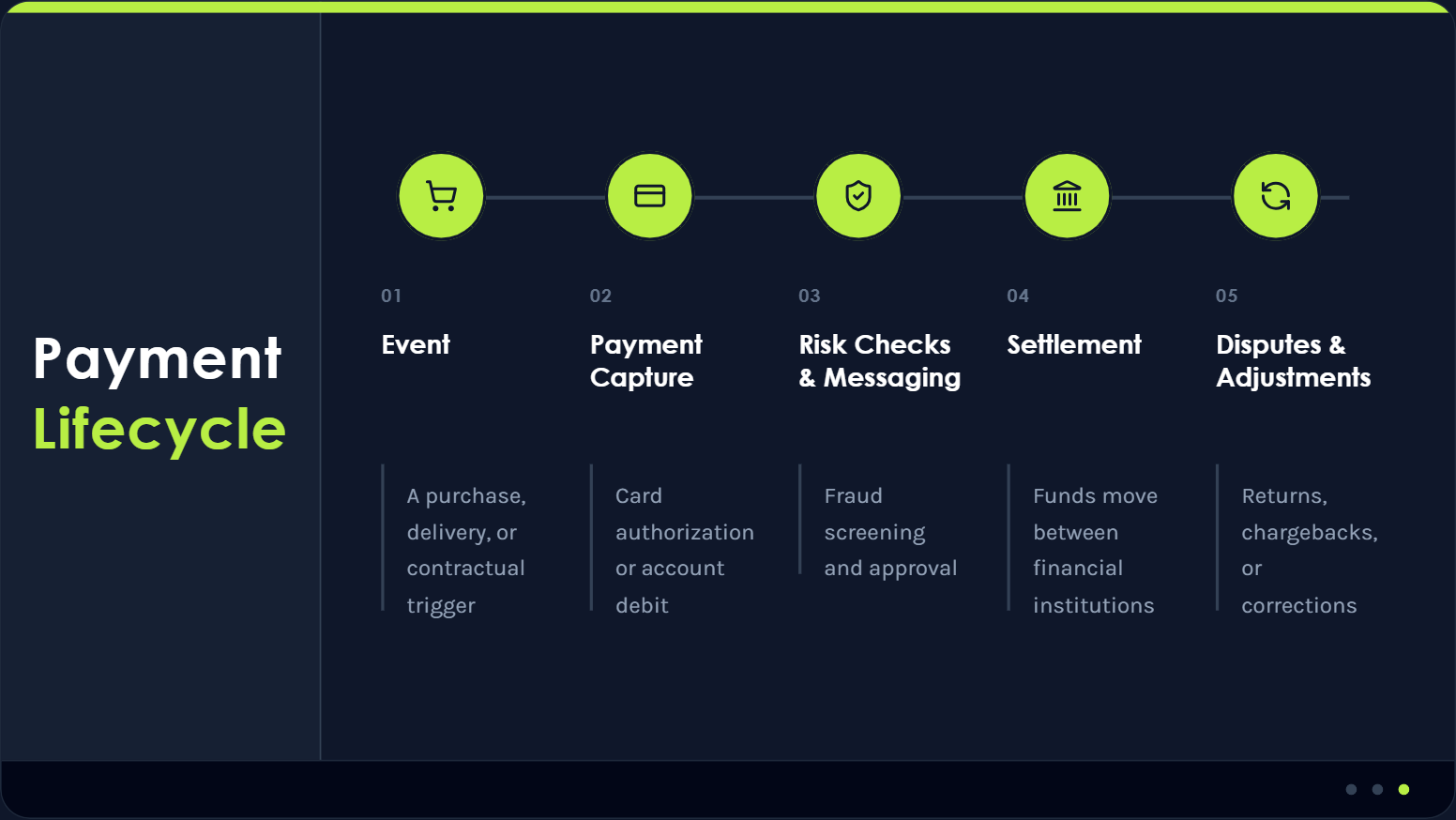
Regardless of the rail, every payment follows a familiar lifecycle:- Event: A purchase, delivery, or contractual trigger
- Payment Capture: Card authorization or account debit
- Risk Checks & Messaging: Fraud screening and approval
- Settlement: Funds move between financial institutions
- Disputes & Adjustments: Returns, chargebacks, or corrections
In card and ACH systems, these steps are handled by different parties across separate platforms. That distribution helps manage risk, but it also fragments context. No single participant sees the full picture of why money moved, when it should settle, or what conditions apply.
For merchants, this often translates into delayed access to funds and time-consuming reconciliation. Most card payments settle 1 to 3 business days after authorization, depending on the network and processor. Some processors offer same-day or next-day funding, but those options typically rely on prefunding or balance advances rather than real-time settlement on the underlying rail. Instant payment networks such as the RTP® network and the FedNow® Service address this delay by settling transactions immediately and irrevocably. Even so, they rely on external systems and processes to handle conditional checks and operational workflows.