Payments are evolving rapidly, and with the rise of real-time and same-day payment rails, processes that once operated behind the scenes—such as account verification—are now becoming critical to both risk management and customer experience. Legacy validation methods, built for slower settlement cycles, are increasingly misaligned with a payments environment defined by immediacy and minimal tolerance for friction.
In a Bank Director–hosted webinar, Crafting a Successful Commercial Payments Strategy, Paul Steinbrecher, Director of Payments Consulting, and Neeraj Gupta, then SVP of Product Management at Alacriti, explored how financial institutions can rethink their commercial payments strategies to better align with these shifts. The discussion examined how instant payments are reshaping commercial payment expectations, the limitations of outdated infrastructure, and the role of modern technologies—including Request for Payment (RfP) and Banking-as-a-Service (BaaS)—in enabling new use cases, strengthening client relationships, and positioning payments as a strategic driver of growth.
Quick Links
Audience Poll: Which Payments Innovation Would Deliver the Most Value to Your Commercial Clients?
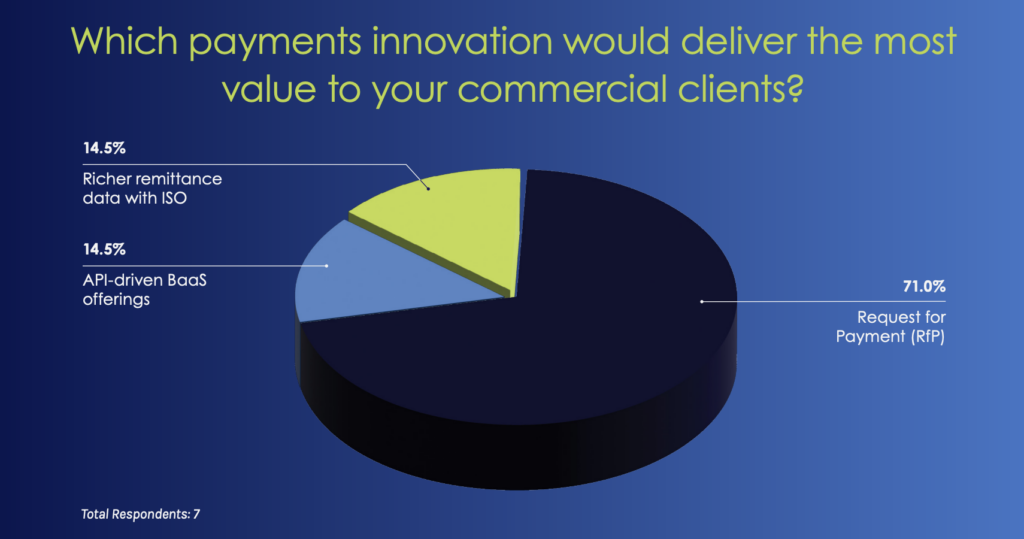
Early in the session, attendees were asked to identify where they see the most value emerging for their commercial clients. The results were decisive: Request for Payment (RfP) stood out as the clear frontrunner, significantly outpacing both ISO 20022-driven remittance enhancements and API-driven/BaaS offerings.
With 71% of respondents selecting RfP, the poll highlights a strong alignment between market demand and real-time payment capabilities. In comparison, richer remittance data and API-driven BaaS each received 14.5%, suggesting that while those innovations remain important, they are viewed as secondary to solutions that directly impact payment execution.
As Steinbrecher noted when reviewing the results, “Not a surprise there, obviously a hot topic.” Gupta echoed the sentiment, adding that RfP’s strong showing was expected and “really well timed.”
RfP is no longer just an emerging capability—it is quickly becoming a focal point for institutions looking to modernize commercial payments and deliver more responsive, real-time experiences.
Competitive Landscape in Commercial Payments
Commercial payments are no longer a stable, back-office function— they’ve become a rapidly evolving battleground where financial institutions are competing not only with each other, but increasingly with fintech providers. What was once a gradual shift has accelerated into a structural change in how businesses consume financial services.
As Gupta noted, “The pace of fintechs eating into that addressable market for banks in the U.S. has never been more rapid.” This acceleration is clearly reflected in adoption trends. A growing majority of corporate clients are already leveraging fintech solutions for payments, treasury, and cash management, often alongside their primary financial institution. Many are not just experimenting—they are actively diversifying providers. Importantly, this shift extends beyond large enterprises
What’s driving this behavior is not a single factor, but a consistent set of structural advantages fintechs bring to market. Legacy infrastructure remains one of the biggest constraints for financial institutions, limiting their ability to innovate quickly or deliver real-time experiences. In contrast, fintechs—unburdened by decades-old systems—can move faster, iterate more quickly, and deliver highly targeted solutions.
Limitations of Legacy Infrastructure
Speed to market is another key differentiator. Financial institutions must navigate regulatory and compliance requirements that can slow innovation, while fintechs are often perceived as more agile and responsive to evolving client needs. This is compounded by rising user experience expectations. Commercial clients increasingly expect the same intuitive, seamless interactions they encounter in consumer applications—something fintechs have prioritized from onboarding through day-to-day use.
Finally, focus plays a critical role. While financial institutions manage multiple lines of business and competing priorities, fintechs often concentrate on a single problem or vertical. This allows them to go deeper, deliver more specialized functionality, and create more compelling client experiences.
In response, financial institutions are not standing still. As outlined in the discussion, many are pulling a set of strategic levers to remain competitive—driving revenue growth through new pricing models and services, strengthening their value proposition through improved cash flow and liquidity management, and driving operational efficiency through automation and cost reduction. At the same time, they are expanding into new markets and use cases, including embedded finance and partnerships with fintechs themselves.
However, execution remains constrained by legacy systems and processes. Delayed settlement cycles, limited payment windows, manual reconciliation, and lack of real-time visibility continue to create friction for both institutions and their clients. These limitations not only increase operational costs but also weaken the overall value proposition—particularly when compared to fintech alternatives that offer faster, more transparent, and more integrated experiences.
Instant Payments at the Core
Speed is no longer a differentiator—it’s an expectation. Businesses are increasingly operating in real time, and payments must keep pace.
This shift goes beyond faster transactions. Instant payments are fundamentally reshaping how businesses manage cash flow, reconcile payments, and interact with suppliers and customers. Real-time settlement eliminates delays, reduces uncertainty, and enables more dynamic financial decision-making—particularly in working capital and liquidity management.
Equally important is the operational impact. Instant payments reduce manual intervention and support automation across the payment lifecycle. “Efficiency and automation are of utmost importance to FIs, but also bolster the proposition for corporates,” Gupta emphasized.
From instant invoice settlement to on-demand disbursements, these capabilities are transforming commercial workflows. More importantly, they are enabling new use cases and revenue opportunities— supporting innovations like real-time payroll, just-in-time supplier payments, and embedded financial experiences.
Instant payments are not just a proposition on their own; they also drive meaningful efficiencies and create powerful downstream effects, enabling broader strategic initiatives. As adoption grows, instant payments are shifting from an optional capability to a strategic necessity.
Audience Poll: Which Commercial Use Case for Instant Payments Is Most Relevant to Your Clients?
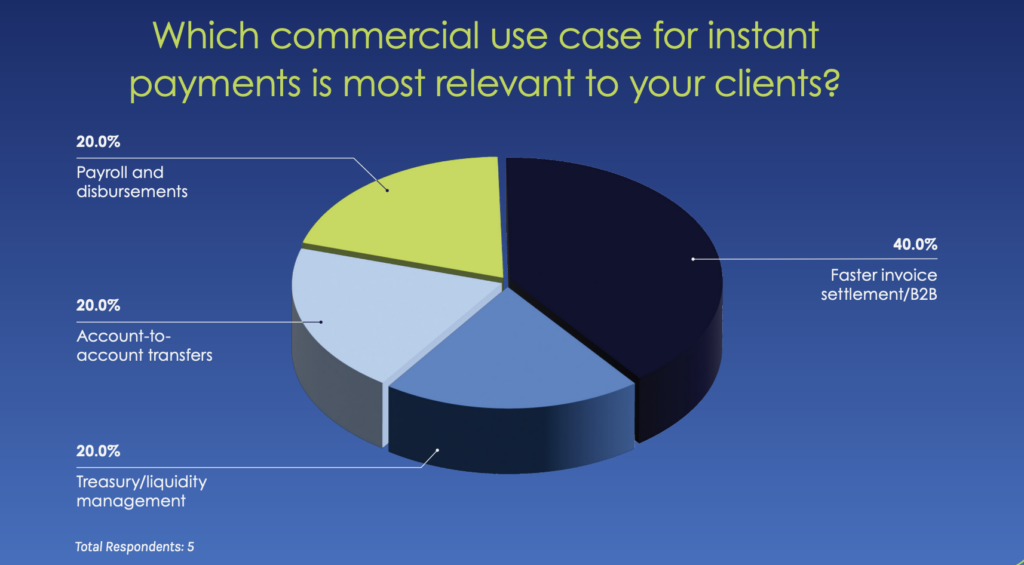
As the discussion shifted from strategy to execution, attendees were asked to identify where instant payments are delivering the most value today. The results showed a clear priority: faster invoice settlement for B2B payments emerged as the leading use case, cited by 40% of respondents. Payroll and disbursements, account-to-account transfers, and treasury/liquidity management each followed at 20%, reflecting a more even distribution across these secondary use cases.
This outcome supports the sentiment that commercial clients are primarily focused on improving cash flow and accelerating the movement of funds between businesses. Invoice settlement sits at the core of this challenge. Delays in receivables can disrupt cash forecasting, strain supplier relationships, and increase reliance on manual follow-ups. Instant payments directly address these issues by enabling real-time settlement and immediate confirmation.
While invoice settlement led the results, the even distribution across the remaining options (each at 20%) highlights that demand for instant payments is not limited to a single use case. Payroll and disbursements reflect growing expectations for on-demand access to funds, particularly in the gig economy and time-sensitive payout scenarios. Account-to-account transfers enable businesses to move funds internally with greater speed and precision, while treasury and liquidity management use cases point to the increasing importance of real-time visibility and control over cash positions. Gupta noted that instant payments support “faster time to cash, a more automated process, and operational simplicity.”
Financial institutions are no longer evaluating instant payments in isolation—they are aligning them to specific business outcomes. Those who succeed will be the ones who connect real-time capabilities to tangible value, starting with high-impact use cases like invoice settlement and expanding outward into adjacent areas of the commercial payments lifecycle.
Challenges Your Clients Are Facing:
BaaS addresses these challenges by allowing financial institutions to provide the underlying infrastructure while partners deliver the frontend experience. This creates significant opportunities for financial institutions—not only to support clients more effectively, but also to expand their role in the broader payments ecosystem.
Steinbrecher highlighted the upside: “You can reach new segments that maybe you aren’t able to reach because they’re already there.” Beyond market expansion, BaaS drives revenue through increased transaction volume, new fee structures, and deeper client engagement. It also accelerates innovation by leveraging API-driven architectures that support faster integration and deployment. Just as importantly, it provides greater control and visibility across payment flows—enabling them to manage settlement, reconciliation, and exception handling more efficiently while supporting multiple partners from a single platform.
BaaS allows financial institutions to shift from competing with fintechs to partnering with them—unlocking new growth while modernizing their own capabilities.
For SMBs, speed and immediacy are no longer optional—they are essential for managing day-to-day business activities. Traditional payment methods often involve delays, manual processes, or additional costs, and are increasingly misaligned with these needs. In contrast, P2P-enabled solutions offer near real-time access to funds, streamlined workflows, and reduced reliance on intermediaries.
The appeal is straightforward. Faster payments improve cash flow, allowing businesses to access funds immediately rather than waiting for checks to clear or card settlements to complete. Simplicity reduces operational overhead, eliminating the need for specialized hardware or complex payment setups. And because transactions are integrated within the financial institution’s platform, businesses can manage payments alongside their broader financial activities.
The Role of Request for Payment (RfP)
As instant payments mature, RfP is emerging as a key capability that enhances both control and efficiency in commercial transactions. While real-time payment rails like the RTP® network and the FedNow® Service are inherently push-based, RfP fills a critical gap by enabling a structured way to initiate payments while preserving the speed and certainty of real-time settlement.
RfP introduces a new model for initiating payments—one that shifts control to the payer while maintaining real-time execution. Instead of pulling funds, the payee sends a request that the payer can review and approve, creating a more transparent and collaborative payment experience.
This payer-controlled model reduces uncertainty and eliminates many of the risks associated with traditional pull-based methods. Because payments are authorized and settled in real time, they carry a higher degree of certainty and significantly lower exception rates—particularly compared to ACH, where returns and insufficient funds can create downstream operational challenges.
“Having fully validated good funds can remove a lot of those exceptions and also give full validation and confidence that a payment has actually been received,” Steinbrecher emphasized. Beyond risk reduction, RfP delivers meaningful operational and financial benefits. It supports 24/7 payment initiation and settlement, removing constraints tied to business hours or batch cycles. It can also reduce processing costs, particularly for higher-value transactions that might otherwise rely on more expensive rails. Just as important, it improves communication between payer and payee by embedding payment requests directly into the transaction flow rather than relying on disconnected invoicing and payment processes.
RfP also enables a wide range of high-value use cases across both commercial and consumer contexts. In B2B environments, it can streamline invoice payments by allowing businesses to request and receive funds instantly, improving accounts receivable cycles and reducing days’ sales outstanding. In bill pay scenarios, organizations can send real-time payment requests, reducing delays and late payments. More complex use cases—such as property closings— highlight the unique value of RfP, where funds can be requested, approved, and settled instantly while all parties are present, reducing fraud risk and eliminating timing constraints.
Additionally, RfP supports just-in-time payment scenarios in which businesses prefer not to rely on pre-authorized debits. By allowing payers to approve payments the moment funds are available, RfP provides greater flexibility while maintaining control and certainty for both parties.
Despite its potential, adoption remains in the early stages. While real-time credit push payments have gained traction, RfP requires a more coordinated ecosystem to scale. Broader bank enablement is essential to ensure that more institutions can both send and receive RfP messages. Equally important is the need for seamless, integrated user experiences—RfP must be embedded into digital banking and treasury platforms in a way that makes reviewing and approving requests intuitive.
Fraud and risk management also play a critical role. While real-time rails have made significant progress in areas like OFAC screening and anomaly detection, RfP introduces additional considerations around identity verification and user authentication. Strengthening these controls will be key to building trust and driving broader adoption.
Taken together, RfP represents more than just a feature layered onto instant payments—it is a strategic capability that enhances how payments are initiated, authorized, and completed. By combining real-time speed with payer control and improved transparency, RfP addresses many limitations of traditional payment methods while enabling new, more dynamic use cases.
As financial institutions continue to modernize their payments infrastructure, RfP stands out as a natural evolution of real-time payments—one that aligns closely with the needs of modern commercial clients and the expectations of an increasingly realtime economy.
The Future of Commercial Payments
The evolution of commercial payments is no longer theoretical—it is actively reshaping how financial institutions compete, operate, and deliver value to their clients. What was once a supporting function is now a strategic lever, and the path forward is defined not by a single capability, but by how elements like instant payments, Banking-asa-Service, and Request for Payment work together to drive speed, efficiency, reach, and control.
At the same time, fintech competition and legacy infrastructure constraints are accelerating the need for action, shifting the conversation from whether to modernize to how quickly and strategically it can be done. The institutions that succeed will be those that align their payments strategy to tangible business outcomes— improving cash flow, reducing friction, and delivering more responsive, real-time experiences—positioning payments as a driver of growth, differentiation, and long-term relevance.
To learn more about how financial institutions are modernizing commercial payments strategies and leveraging real-time capabilities, watch the full webinar, Crafting a Successful Commercial Payments Strategy.
Alacriti’s centralized payment platform, Orbipay Payments Hub, provides innovation opportunities and the ability to make smart routing decisions at the financial institution to meet their individual needs. Financial institutions can take full ownership of their payments and control their evolution with TCH’s RTP® network, the FedNow® Service, Zelle®, Fedwire, ACH, and Visa Direct, all on one cloud-based platform. Alacriti’s Orbipay Loan Payments is a customizable electronic billing and payments solution for businesses and financial institutions of all sizes. Orbipay Loan Payments offers convenient and flexible choices that include all the payment channels, payment methods, and payment options expected from a modern digital bill pay experience.